
Content
How to apply textile DTF: step-by-step transfer guide
From PET film printing to the finished fabric print: every step of the DTF application process, what a heat press is, and what you need to confirm before production.
Published on
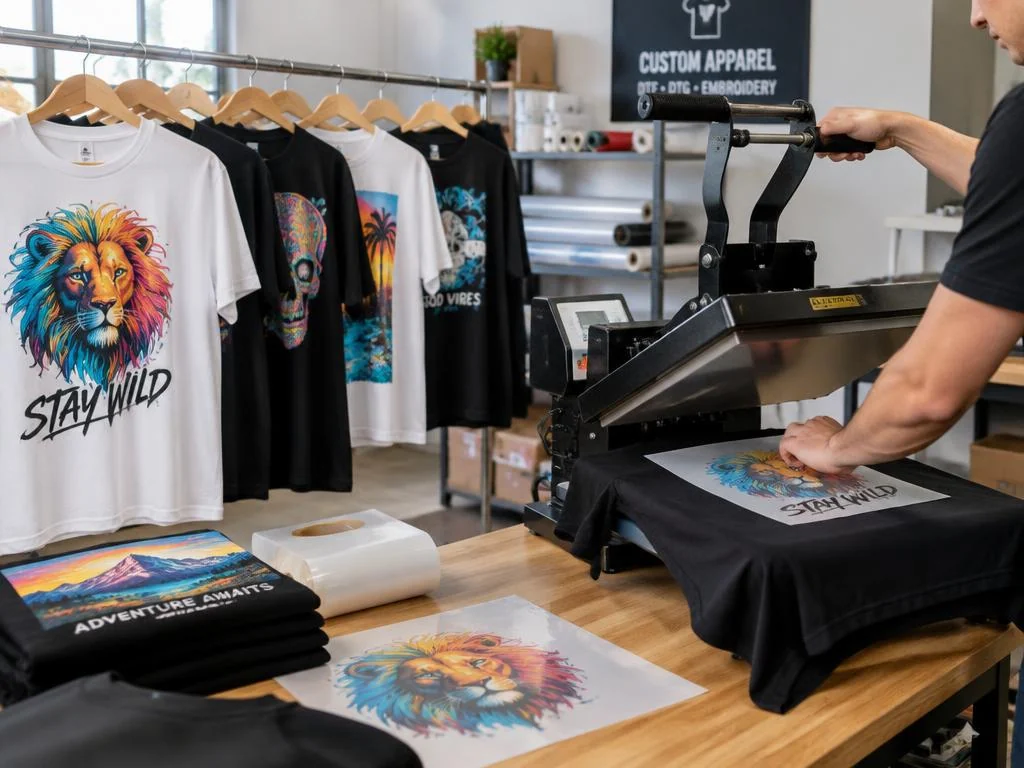
How to apply textile DTF?
Applying textile DTF means transferring a design printed on PET film onto fabric. The printer does not touch the shirt: it produces the transfer. Application takes place afterward, using adhesive powder, curing, and a heat press. Understanding the sequence of steps prevents the most common beginner mistake, which is buying the printer thinking it prints directly onto the garment.
Step 1, print on the film. The artwork is prepared on the computer and sent to the DTF printer's RIP software, which prints the artwork onto the special PET film. PRIME line printers work with adjustable media thickness from 1.5 mm to 8 mm and resolution up to 1440 dpi, featuring a pass-mark-free function for gradients.
Step 2, apply the adhesive powder. Adhesive powder, called hot melt, is spread over the still-wet ink. This is what will hold the print onto the fabric after heating.
Step 3, cure. The film goes through heating to bond the powder to the print. PRIME printers feature separately controlled pre- and post-print media heaters, providing greater control during film printing.
Step 4, press. The transfer is positioned over the garment in a heat press. This is where time, temperature, and press pressure come into play — parameters that vary depending on film, powder, and fabric. TEKNOVA recommends confirming these numbers with the technical team and media supplier rather than relying on guesswork.
Step 5, peel the film. After pressing, the PET film is removed, leaving the print on the fabric. The result is a flexible print with solid color, white ink capability, and gradients, suitable for cotton and polyester.
What you need to produce: the DTF printer, special PET film, adhesive powder, a curing unit, and a heat press. The PRIME DTF Têxtil 30X produces 6 m²/h across a 30 cm width; the PRIME DTF Têxtil 60X produces up to 10 m²/h across 60 cm, allowing you to gang multiple artworks side by side on the same meter of film.
In practice, the application process is what defines print durability, not the printer alone. Therefore, when setting up your operation, consider machine output, media consumption, and heat press time, and validate the setup with TEKNOVA's technical team before finalizing your purchase.