
Content
What is textile DTF and how the print transfers to the fabric
Textile DTF is printing artwork onto PET film that is then transferred to fabric with adhesive powder and a heat press. Check out the step-by-step process and what you can produce.
Published on
What is textile DTF?
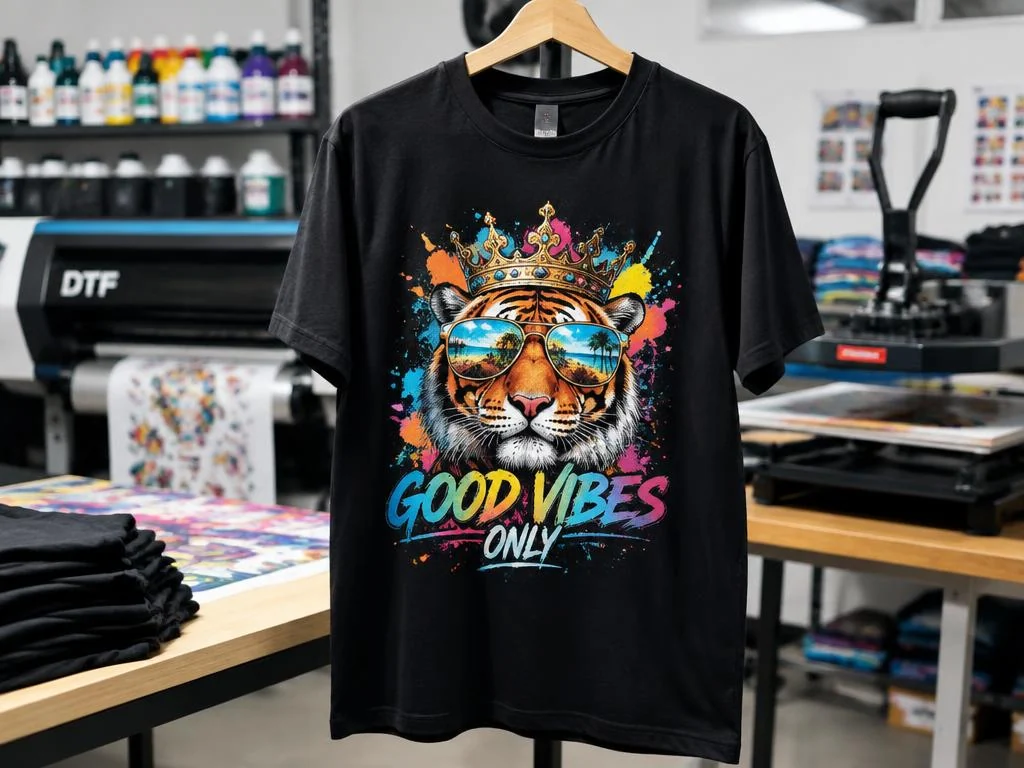
DTF comes from Direct to Film: the printer does not print directly on the garment, it prints the artwork onto a PET film. This print becomes a transfer, which is applied to the fabric using heat and pressure. The result is a flexible print with solid colors and gradient capabilities that works on both cotton and polyester.
The process has six steps. Artwork is prepared on the computer and sent to the RIP software; the printer prints onto the PET film; adhesive powder (hot melt) is applied over the still-wet ink; the film undergoes heating to cure the powder onto the print; the transfer is positioned on the garment in a heat press; and, after pressing, the film is peeled away, leaving the design on the fabric.
This changes what you need to produce. A DTF printer alone does not print t-shirts: it produces the transfer. To complete the cycle, you need special PET film, adhesive powder, a curing method, and a heat press. It is worth confirming film and ink compatibility with the technical team before purchasing, as this pairing defines the final quality.
In the TEKNOVA line, the PRIME DTF Têxtil 30X prints at 30 cm width, with 2 Epson i1600-A1 heads and an output of 6 m²/h. The PRIME DTF Têxtil 60X prints at 60 cm, with 2 Epson i3200-A1 heads and up to 10 m²/h. Both feature up to 1440 dpi resolution, feathering function for seamless gradients, independently controlled pre- and post-print media heaters, a front dual-motor take-up system, and SAI PhotoPrint or FlexiPrint RIP software.
What can be produced: t-shirts, uniforms, hoodies, custom apparel, fashion brand collections, on-demand products, and garment printing in general. The 60 cm width allows you to gang multiple smaller artworks side by side on the same meter of film, reducing waste in varied print runs.
The difference compared to sublimation lies in the starting point: sublimation requires light polyester and a specific coating, while DTF is a transfer applied directly to the item—making room for cotton and designs with white and gradients. The detailed comparison is in the guide DTF or sublimation: which to choose.
Before purchasing, define what you will print, daily volume, and available space. TEKNOVA provides online training with courses, remote installation, lifetime technical support, and a 12-month warranty, guiding your choice between 30X and 60X based on your production volume.